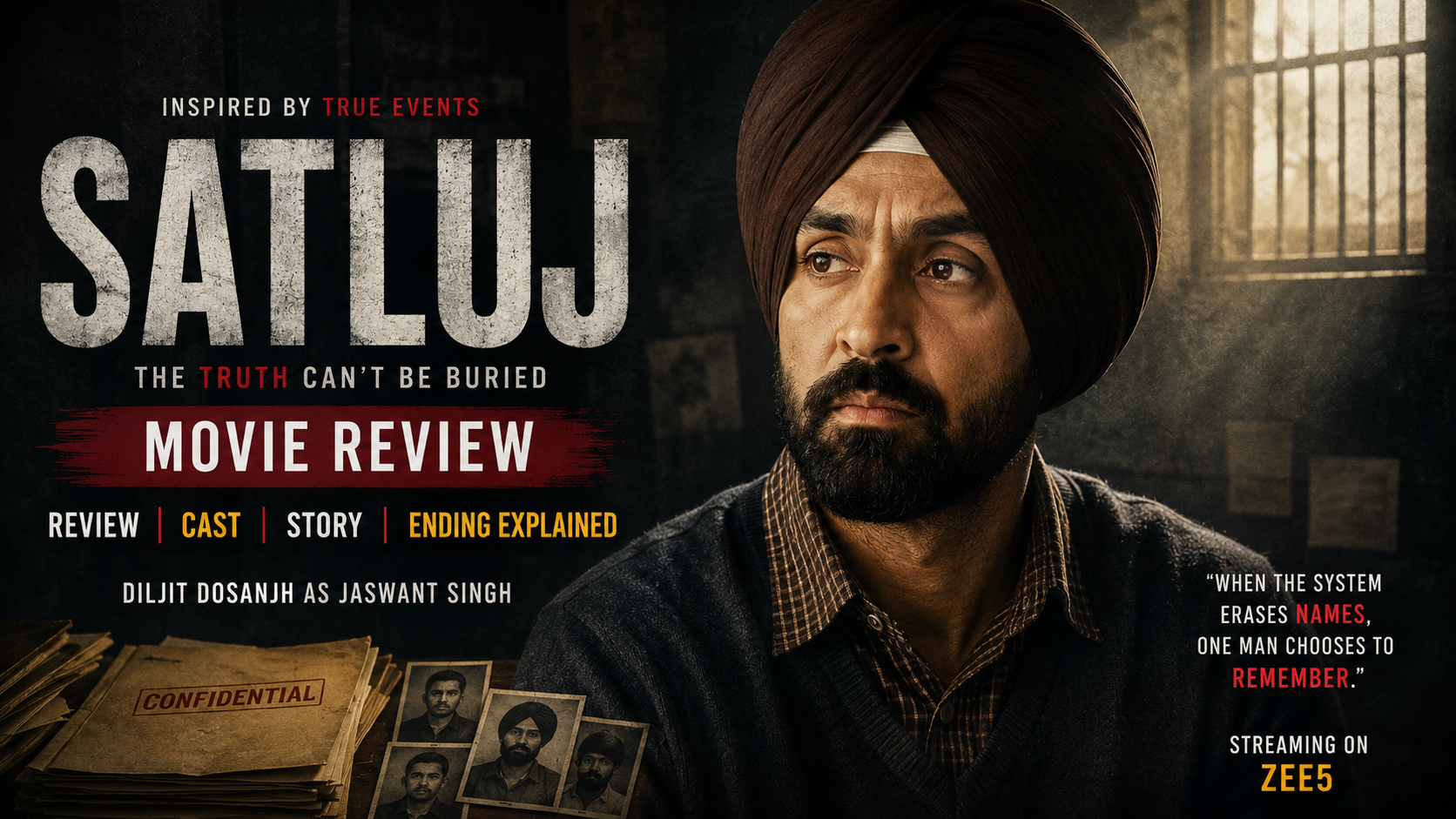
Satluj Movie Review: Cast, Story, Ending Explained, OTT Release & Full Details: Satluj is not the kind of film you “watch and move on” from. It is heavy, unsettling, politically charged, and emotionally exhausting in a way that feels deliberate. Directed by Honey Trehan and led by a deeply controlled performance from Diljit Dosanjh, the film turns the life and struggle of human-rights activist Jaswant Singh Khalra into a haunting crime drama about disappearances, state power, fear, and memory. Released on ZEE5 on 3 July 2026 after a long and highly public battle over certification and title changes, Satluj has quickly become one of the most talked-about Indian OTT releases of the year.
The film was earlier known as Punjab ’95 and, before that, Ghallughara. That journey matters because it explains why Satluj already carried the weight of controversy before audiences even pressed play. The final release has reignited discussion around censorship, political memory, and whether difficult historical stories in Indian cinema are still allowed to breathe in their original form. Reports around the release indicate that the OTT version finally arrived after years of delays and a fight over a very large number of proposed cuts.
If you are looking for a full review of Satluj, plus cast details, story summary, latest news, and an ending explained section, here is the complete breakdown.
Also Read: Alpha Movie Review 2026: A Stylish Spy Thriller with Big Expectations and Mixed Reactions
Satluj Movie Overview
- Movie: Satluj
- Earlier titles: Punjab ’95, Ghallughara
- Director: Honey Trehan
- Writers: Honey Trehan, Niren Bhatt, Utsav Maitra
- Lead cast: Diljit Dosanjh, Arjun Rampal, Suvinder Vicky, Geetika Vidya Ohlyan, Kanwaljit Singh, Jagjeet Sandhu
- Genre: Political drama / crime drama / biographical thriller
- Language: Hindi and Punjabi
- Platform: ZEE5
- Release date: 3 July 2026
- Runtime: Around 2 hours 43 minutes according to IMDb listings.
Satluj Movie Review: Short Verdict
Rating: 4.5/5
Satluj is a difficult but essential watch. It is not “mass entertainment,” and it doesn’t try to be. Honey Trehan directs it like a film that knows exactly how much pain it is carrying. Diljit Dosanjh gives one of the finest performances of his career, not by turning Jaswant Singh into a larger-than-life hero, but by playing him as an ordinary man who slowly understands the size of the darkness he is walking into. The result is a film that is gripping, angry, and deeply sad without becoming melodramatic.
If you are expecting a typical courtroom thriller, police procedural, or loud political biopic, Satluj may surprise you. It is much quieter and more grounded than that. Its power comes from restraint. It keeps returning to paperwork, testimonies, cremation records, ordinary homes, and silent dread—because that is the point. This is a film about how horror can hide behind routine.
What Is Satluj About?
At its core, Satluj follows Jaswant Singh, a bank manager and human-rights activist in Punjab, who becomes obsessed with finding the truth behind a growing pattern of disappearances, custodial killings, and unidentified cremations during the militancy years. What begins as a search for one missing relative gradually opens up into a much larger investigation involving records, police abuse, political intimidation, and the machinery of fear.
The film is inspired by the life and work of Jaswant Singh Khalra, the activist who documented alleged illegal cremations and disappearances in Punjab. Review coverage and the film’s promotional material make it clear that Satluj is essentially the long-delayed Punjab ’95 under a new title, with the same emotional and political core intact.
This matters because Satluj is not just trying to tell one man’s story. It is trying to dramatize a climate—an era in which the state, militancy, grief, and silence all collided, and where truth itself became dangerous.
Satluj Cast and Characters
The performances are one of the film’s biggest strengths. The casting feels deliberate and unusually grounded.
Diljit Dosanjh as Jaswant Singh
Diljit carries the film with remarkable control. He does not perform Jaswant as a fiery revolutionary from scene one. Instead, he begins as a decent, observant, emotionally available man who slowly realizes that the evidence in front of him points to something far bigger and far more dangerous than he imagined. The performance works because Diljit underplays it. He allows the moral conviction to build from inside the character instead of announcing it loudly.
Arjun Rampal as Samudra Singh
Arjun Rampal brings a polished menace to the film. He is not cartoonishly evil, and that makes him more effective. His presence embodies the confidence of power—the kind of power that does not need to shout because it assumes impunity.
Suvinder Vicky as Surjit Singh Sugga
Suvinder Vicky is outstanding. He brings unpredictability, intimidation, and moral rot to the role. Many early audience reactions have singled him out as one of the most disturbing and memorable parts of the film, and that feels justified.
Geetika Vidya Ohlyan as Paramjit Kaur
Geetika gives the film its emotional grounding. In a story built around public courage and political violence, her performance reminds you of the private cost—the fear inside a home, the loneliness of waiting, and the strength required to stand beside someone who has decided to challenge a system.
Supporting cast
Actors like Kanwaljit Singh, Jagjeet Sandhu, and others help create a world that feels lived-in rather than theatrical. There are no “filler” performances here; even smaller characters feel like people shaped by the same atmosphere of suspicion and fear.
Story Summary: How Satluj Builds Its Tension
One of the smartest things Satluj does is refuse to build itself like a whodunit. It is not asking, “Did something terrible happen?” The film makes the moral and political ugliness visible early. The tension comes from a different question: What happens when an ordinary person keeps following the paper trail, even after everyone around him understands the cost?
Jaswant begins with specific disappearances and suspicious cremation records. He notices inconsistencies. Names do not match. Bodies are being processed without identity. Families are being left with no answers. Slowly, he pieces together a larger pattern. Each new discovery pushes him closer to a truth that institutions would prefer remain buried.
As the film moves forward, it becomes less about investigation in the traditional thriller sense and more about endurance. Jaswant is not chasing one villain; he is pushing against a system that has normalized erasure. The police, bureaucracy, and political structures in the film are not portrayed as cleanly separable. They overlap. That overlap is where the film’s dread comes from.
Honey Trehan’s direction is strongest in these stretches. He understands that dread is more frightening when it feels procedural. There are scenes in Satluj where a register, a file, or a quiet conversation feels more dangerous than a gunfight.
What Works in Satluj
1) Diljit Dosanjh’s performance is career-best material
This is one of those roles where Diljit’s restraint becomes his greatest weapon. He does not turn Jaswant into a slogan. He plays him as a husband, a father, a citizen, and then a witness—someone who can no longer look away once he has seen enough. The emotional power of the performance comes from that progression.
2) Honey Trehan refuses to sensationalise suffering
A lesser film might have chased shock value. Satluj doesn’t. It is full of violence in implication, memory, and consequence, but it does not stage itself like a thriller built around “big reveals.” It is more interested in how violence changes rooms, marriages, conversations, and silences.
3) The atmosphere is suffocating in the right way
The film captures the feeling of a society where everyone knows more than they are willing to say aloud. There is fear in the homes, in the offices, in the body language of bystanders. This atmosphere is one of the film’s biggest achievements.
4) It trusts the audience
Satluj does not over-explain its politics every five minutes. It assumes viewers can understand implication, history, and contradiction. That makes it feel more mature than many recent issue-based dramas.
What May Not Work for Every Viewer
1) It is emotionally draining
This is not a casual Friday-night watch. The film is heavy from beginning to end. If you’re looking for entertainment in the usual sense, Satluj is likely to feel exhausting.
2) The pacing is intentionally measured
Some viewers may find the film slow, especially in the middle stretches where the focus stays on records, investigation, and mounting pressure rather than plot twists. Personally, I think the pacing suits the material, but it won’t work for everyone.
3) It demands context and attention
Even though the film works on an emotional level without a deep knowledge of Punjab’s history, it becomes far richer if you understand the period it is drawing from. Viewers unfamiliar with that context may want to read up a little after watching.
Satluj Review of Acting, Direction, Music and Technical Aspects
Direction
Honey Trehan deserves a lot of credit here. This film could easily have become either too cautious or too preachy. Instead, he keeps it grounded, mournful, and politically alert. He doesn’t flatten the world into heroes and monsters; he shows how fear operates structurally.
Screenplay
The screenplay is less interested in twist mechanics and more interested in accumulation. Every discovery, every confrontation, every warning adds weight. That structure won’t feel “fast” to everyone, but it is effective.
Cinematography
The visual tone suits the story—muted, tense, and often deliberately unglamorous. Nothing in the film is shot to make trauma look stylish. That restraint matters.
Background score and sound
The score supports rather than manipulates. It heightens unease instead of begging for tears. That is exactly the right choice for a film like this.
Satluj Ending Explained: What the Final Act Really Means
Spoiler warning: This section discusses the final stretch of the film.
The ending of Satluj works because it refuses the comfort of a clean “victory” structure. If you go into the film expecting a conventional payoff where truth is exposed, justice is delivered, and the system is morally corrected, Satluj deliberately denies that simplicity.
By the final act, Jaswant has done what the film has been building toward all along: he has gathered enough evidence to turn suspicion into something far more dangerous for the people in power—a documented accusation. And that is the key. Satluj is not saying that truth automatically wins. It is saying that truth becomes threatening the moment it is documented, organized, and made public.
The ending is devastating because the film understands that exposing a system does not guarantee safety from that system. Jaswant’s journey is framed less as a triumphant crusade and more as a moral crossing of a line: once he chooses to keep going, he knows there may be no way back to an ordinary life.
So what does the ending mean?
The ending of Satluj is really about the cost of witness.
Jaswant is not presented as a superhero who can defeat the machine. He is presented as someone who insists on naming what others want erased. The final stretch underlines three big ideas:
1) The film is about memory, not closure
The ending doesn’t exist to “solve” history for the audience. It exists to make sure the audience cannot easily forget it. That is why the emotional aftertaste of the film is grief mixed with anger rather than relief.
2) Documentation is resistance
Throughout the film, paper trails, testimonies, records, and names matter. The ending reinforces that idea. In a world built on denial, keeping a record becomes an act of defiance.
3) Satluj sees activism as deeply human, not mythic
The film never turns Jaswant into a flawless icon. That’s important. The ending lands because he still feels like a husband, father, and citizen who made a terrifying moral choice—not a fantasy savior dropped into history.
Is the ending “satisfying”?
Emotionally, yes. Comfortingly, no.
It is satisfying in the sense that the film remains honest to its own worldview and to the pain of its subject. But it is not satisfying if what you want is neat justice. Satluj is interested in something harder: what it means to continue telling the truth when truth itself has become dangerous.
Is Satluj Based on a True Story?
Yes, it is inspired by the life and activism of Jaswant Singh Khalra, the Punjab human-rights activist who investigated alleged illegal cremations and disappearances. Reviews, coverage around the release, and the film’s long road from Punjab ’95 to Satluj all point clearly to that inspiration.
That said, as with many films inspired by real events, viewers should remember that cinema compresses, dramatizes, and structures material for narrative impact. Satluj is best understood as a dramatized political film rooted in a real historical figure and a real historical climate, rather than a documentary.
Satluj Latest News: Why the Film Was in the Headlines Before Release
Part of the reason Satluj feels like such a major release is because the film had a long and difficult road to audiences.
Here’s the short version:
- The film was earlier titled Punjab ’95 and, before that, Ghallughara.
- It reportedly spent years stuck in certification issues and title-related controversy.
- Reports around the release said the project faced demands for a very large number of cuts before it eventually reached OTT.
- Diljit Dosanjh publicly said he would not have promoted the film if it had been released with cuts that diluted its core, and he later spoke emotionally about the four-year struggle to bring it to audiences.
That history matters because it changes the way the film is received. Satluj is not just being watched as a movie; it is being watched as a film that had to fight to exist in public at all.
Critical Response and Audience Reaction
The critical response so far has been strongly positive, with multiple outlets praising the film’s courage, Diljit’s performance, and Honey Trehan’s refusal to soften the material. NDTV called it an “unmissable film,” while other reviews highlighted its heart-rending treatment of impunity and citizen courage.
Audience response online has also been intense. A lot of viewers are describing it as a film that leaves them numb, angry, and emotionally shaken. On Reddit and discussion forums, the most common praise is for Diljit’s restraint, Suvinder Vicky’s menace, and the feeling that the film doesn’t exploit suffering for easy effect.
Should You Watch Satluj?
Yes—if you’re ready for a serious film.
Watch Satluj if:
- you like political dramas based on real events,
- you appreciate restrained acting over loud melodrama,
- you’re interested in difficult chapters of Indian history,
- you want to see one of Diljit Dosanjh’s strongest performances.
You may want to skip it or postpone it if:
- you’re in the mood for light entertainment,
- you prefer fast-moving thrillers with clear-cut heroes and villains,
- you find stories of state violence and disappearance emotionally overwhelming.
Final Verdict
Satluj is one of the most important Indian films of 2026—not because it is easy to watch, but because it refuses to make itself easy. It asks what happens when a person decides that the missing deserve names, the dead deserve records, and the truth deserves witnesses. Honey Trehan directs with seriousness and moral clarity, and Diljit Dosanjh responds with a performance that feels both deeply internal and quietly devastating.
This is not a perfect film in the conventional “entertainment” sense. It is too grim, too patient, and too politically heavy for that. But those are also the reasons it works. Satluj doesn’t just tell a story. It confronts a silence.
My rating: 4.5/5
FAQ’s
Is Satluj based on a true story?
Yes. Satluj is inspired by the life and work of Jaswant Singh Khalra, the human-rights activist who investigated disappearances and alleged illegal cremations in Punjab.
Who plays the lead role in Satluj?
Diljit Dosanjh plays Jaswant Singh, the film’s central character.
How is Diljit Dosanjh in Satluj?
Diljit is excellent. Many viewers and critics are calling it one of the best performances of his career.