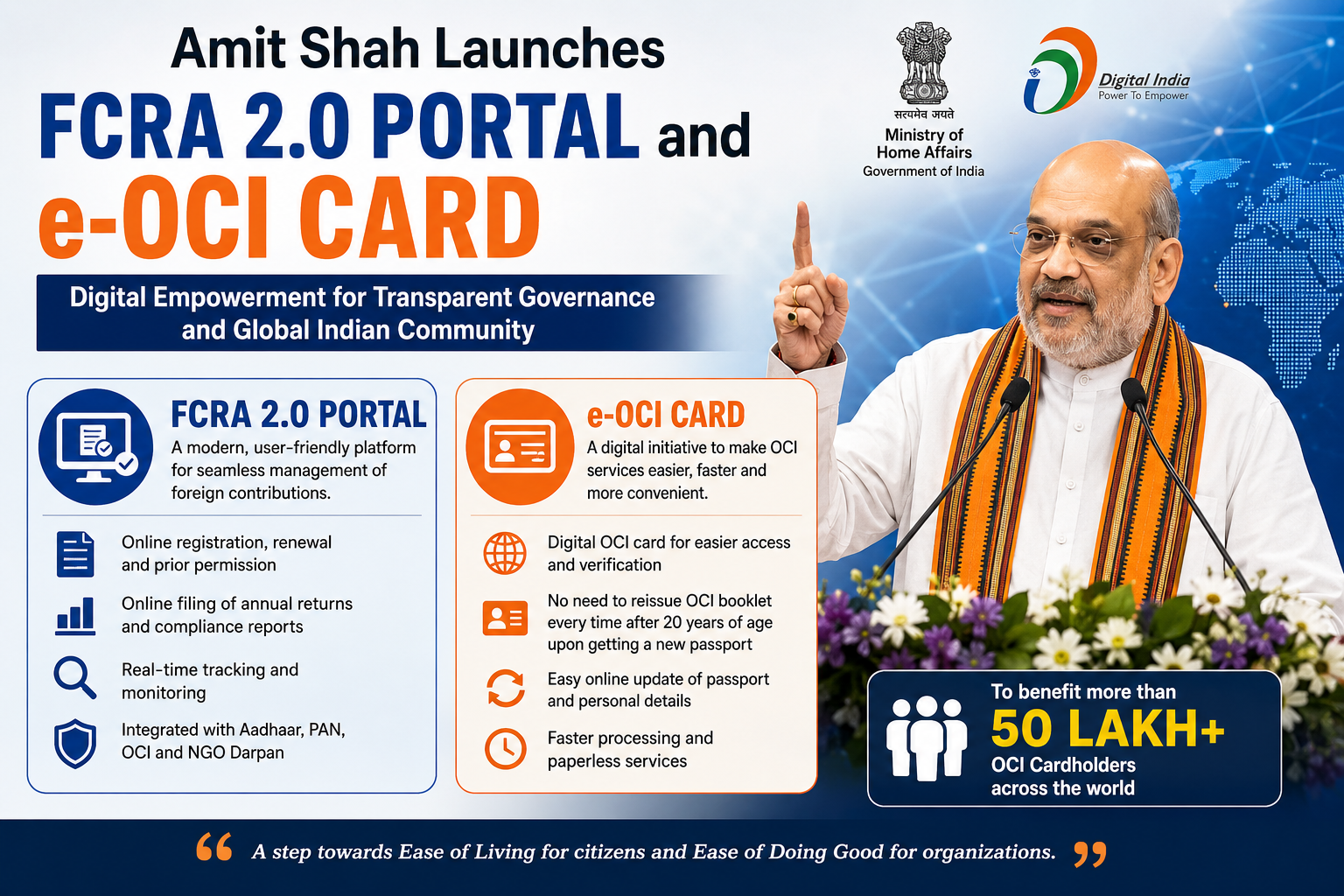
Amit Shah Launches FCRA 2.0 Portal and e-OCI Card: Full Details, Benefits, Purpose, and What It Means for 50 Lakh OCI Cardholders: India has taken another major step toward digital governance and citizen service reform. Union Home Minister Amit Shah has launched the FCRA 2.0 Portal and the e-OCI Card, two initiatives aimed at making official processes faster, more transparent, and more convenient. According to the government, these measures are expected to benefit not only organizations dealing with foreign contributions but also more than 50 lakh OCI cardholders living across the world.
This development is being seen as more than just a technical upgrade. It reflects the government’s broader push toward digital administration, paperless services, faster approvals, and improved monitoring systems. But what exactly are the FCRA 2.0 Portal and the e-OCI Card? Why were they launched, who will benefit, and why is this being described as an important move?
In this article, we break down everything.
Also Read: Sponsored Posts: Complete Guide to Earning Money Through Brand Collaborations
What Did Amit Shah Launch?
Union Home Minister Amit Shah launched two major digital initiatives:
- FCRA 2.0 Portal
- e-OCI Card
The government says these initiatives are designed to improve public services, simplify official procedures, and make systems more secure and user-friendly. While the FCRA 2.0 Portal is focused on streamlining matters related to foreign contributions, the e-OCI Card is intended to make services easier for Overseas Citizen of India (OCI) cardholders around the world.
Together, these initiatives fit into the government’s larger vision of modernizing administrative systems and reducing unnecessary paperwork.
What Is FCRA and Why Is FCRA 2.0 Important?
What Is FCRA?
FCRA stands for Foreign Contribution Regulation Act. It is an Indian law that regulates the acceptance and use of foreign donations or foreign funding by individuals, associations, NGOs, trusts, and certain organizations in India.
The purpose of FCRA is to ensure that foreign contributions are received and used in a lawful, transparent, and accountable manner.
What Is the FCRA 2.0 Portal?
The FCRA 2.0 Portal is a new and upgraded digital platform for services related to the Foreign Contribution Regulation Act. It is designed to bring multiple FCRA-related functions onto one online system.
Earlier, organizations often had to deal with time-consuming procedures, paperwork, compliance difficulties, and delays in approvals or renewals. The FCRA 2.0 Portal aims to reduce these problems by offering a more efficient digital process.
Main Objectives of the FCRA 2.0 Portal
1) Reducing Paperwork
One of the key goals of the portal is to make FCRA-related procedures more paperless. This can reduce the need for repeated physical document submissions and manual processing.
2) Simplifying Registration and Renewal
Organizations that require FCRA registration or renewal may find the process easier and faster under the new system.
3) Digitizing Compliance
Institutions that receive foreign contributions are required to file annual returns and other compliance-related documents. The portal is expected to make this process more centralized and digital.
4) Improving Monitoring of Foreign Funds
The government will be able to monitor foreign contributions more effectively through digital tracking and real-time oversight. This can help authorities understand how foreign funds are being received and used.
5) Increasing Transparency and Accountability
A centralized digital system can improve transparency in applications, approvals, document management, and compliance monitoring. This is one of the biggest reasons the government is highlighting the importance of FCRA 2.0.
Who Will Benefit from the FCRA 2.0 Portal?
The FCRA 2.0 Portal is likely to benefit:
- NGOs receiving foreign donations
- Trusts and charitable institutions
- Societies and non-profit organizations
- Educational, social, and research institutions
- Any organization that needs FCRA registration, renewal, or compliance services
For such organizations, the portal can make application filing, renewal, reporting, and documentation much more convenient.
What Is an e-OCI Card?
What Does OCI Mean?
OCI stands for Overseas Citizen of India. It is a special status granted by the Government of India to foreign citizens of Indian origin. OCI cardholders are given several long-term travel and stay-related benefits in India.
It is important to note that OCI is not full Indian citizenship, but it is a form of lifelong visa and a special facility for people of Indian origin living abroad.
What Is the e-OCI Card?
The e-OCI Card is the digital version of OCI-related services. It is intended to make the OCI system more modern, accessible, and convenient for users.
According to the government, the initiative is expected to benefit over 50 lakh OCI cardholders globally.
Why Was the e-OCI Card Introduced?
Over time, OCI-related procedures have also needed modernization. Many OCI cardholders have faced inconvenience in updating documents, handling passport-related changes, or managing official records. The e-OCI Card has been introduced to make these services more digital and user-friendly.
Key Benefits of the e-OCI Card
1) Greater Digital Convenience
OCI cardholders may be able to access services more easily through digital channels, reducing dependence on physical paperwork.
2) Less Manual Documentation
A digital system can reduce the need for repeated submission of physical forms and supporting documents.
3) Easier Record Updates
Changes related to passport details or personal information may become easier to update through a more organized digital process.
4) Faster Service Delivery
By digitizing processes, the government aims to reduce delays and improve the speed of OCI-related services.
5) Better Experience for the Global Indian Diaspora
For millions of people of Indian origin living overseas, the e-OCI Card represents a move toward more efficient and convenient engagement with India’s administrative system.
How Will 50 Lakh OCI Cardholders Benefit?
The government has stated that more than 50 lakh OCI cardholders worldwide are expected to benefit from the e-OCI initiative. The reason is simple: a digital service model can make the OCI system more efficient, organized, and user-focused.
Potential benefits may include:
- easier document management
- smoother updating of records
- quicker verification and processing
- reduced dependency on physical documents
- less confusion in handling OCI-related formalities
Why Is This Move Important for the Government?
The launch of the FCRA 2.0 Portal and e-OCI Card is not just about service delivery. It also fits into the government’s broader strategy of Digital India, e-governance, administrative reform, and data-driven oversight.
1) Technology-Driven Governance
The government is increasingly moving services online so that people and institutions can avoid unnecessary office visits and lengthy paperwork.
2) Better Record Management
Digital systems allow safer storage, easier retrieval, and more efficient verification of records.
3) Transparent Oversight
In the case of FCRA especially, the monitoring of foreign contributions has always been a sensitive and important policy area. A stronger digital system helps the government maintain oversight more effectively.
4) Faster Processing
Applications, renewals, compliance filings, and verification procedures can all become faster when handled through a centralized digital platform.
Is This Important for Ordinary Citizens Too?
At first glance, these initiatives may seem relevant only to NGOs or overseas Indians. However, their broader significance lies in governance and public administration.
- FCRA 2.0 matters because many NGOs and social organizations work in education, health, relief, research, and development using foreign funding.
- e-OCI Card matters because it affects the Indian diaspora and people of Indian origin who maintain strong ties with India.
So even though the benefits may not directly affect every citizen on a daily basis, these reforms are still important from an administrative and policy perspective.
Political and Policy Significance
FCRA has often been a politically sensitive subject in India because it involves foreign funding, NGOs, regulation, and oversight. For that reason, the launch of FCRA 2.0 is also likely to attract policy debate and political discussion.
The government, however, is presenting the move as a step toward simplification, transparency, and secure administration rather than merely tighter regulation.
In Simple Words: Why Was This Introduced?
If explained in very simple terms, the government introduced these two initiatives for the following reasons:
- to digitize foreign funding-related procedures
- to simplify registration, renewal, and compliance for organizations
- to make OCI services easier for overseas Indians
- to reduce paperwork and delays
- to improve record management and verification
- to bring more transparency and efficiency into the system
Conclusion
The launch of the FCRA 2.0 Portal and e-OCI Card by Union Home Minister Amit Shah marks an important step in India’s digital governance journey. While the FCRA 2.0 Portal is aimed at improving transparency, compliance, and efficiency in the management of foreign contributions, the e-OCI Card is expected to make OCI-related services more convenient for millions of cardholders around the world.
The true impact of these initiatives will depend on how smoothly they are implemented and how effectively users can access their benefits. Still, the direction is clear: the government wants to make administrative systems more digital, transparent, efficient, and user-friendly.
Frequently Asked Questions (FAQs)
1) What is the FCRA 2.0 Portal?
The FCRA 2.0 Portal is a new digital platform for services related to the Foreign Contribution Regulation Act, including registration, renewal, compliance, and reporting.
2) What is an e-OCI Card?
The e-OCI Card is a digital initiative aimed at making OCI-related services easier, faster, and more convenient for Overseas Citizen of India cardholders.
3) Who will benefit from FCRA 2.0?
NGOs, trusts, charitable institutions, and organizations receiving foreign contributions are expected to benefit from the portal.
4) How many people will benefit from the e-OCI Card?
The government says more than 50 lakh OCI cardholders across the world are likely to benefit.
5) Why did the government launch these initiatives?
The main goals are to digitize services, reduce paperwork, improve transparency, speed up processing, and make governance more efficient.